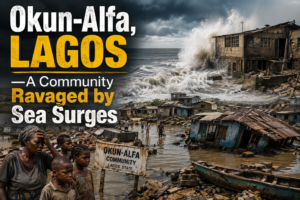

For people who live close to the sea, like the Okun-Alfa community in Eti Osa L.G.A. of Lagos State, the water is more than a beautiful view.
It is where they work, where they find food, where they take their children, and, for many families, where their lives began. However, their community is constantly threatened as a result of the changing nature of the sea.
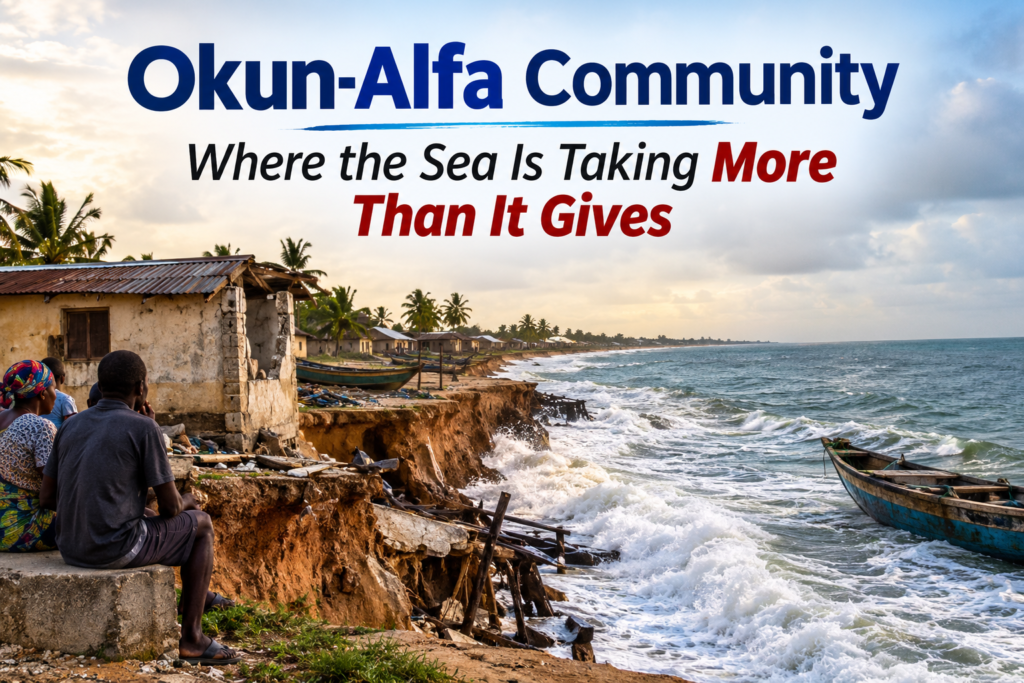
Along the shoreline, people watch familiar places disappear drastically as water comes closer to their homes. The sand is washed away. Fishing becomes harder. Dirty water and plastic waste gather around places where children once played. For those who live far from the coast, environmental damage can sound like a distant problem, but for people living beside the sea, it is something they wake up to every morning.
“The water was not like this before” said Sherif Adekunle, an environmental activist and indigene of the community, who narrated their ordeal to a group of journalists who visited the community on 19th August, 2026. He is a leading voice in the campaign.
According to him, the coastline once offered enough space for people to move around, as he pointed towards the shoreline and remembered how the area looked years ago. Today, parts of that space are gone. The sea has gradually eaten into their land.
Some residents said they have watched houses, trees and other parts of the shoreline disappear after years of erosion and flooding. For families who have spent decades in the area, leaving is not an easy choice. Their homes may be close to the water, but so are their livelihoods. A fisherman who loses access to a safe landing point loses more than a piece of beach. He may lose his income forever. A woman who sells fish may have fewer customers when fishermen return with smaller catches. So also a family whose home floods repeatedly may have to spend money repairing walls, replacing household 6 cleaning muddy water instead of paying school fees or buying food.
The damage is environmental, but the pain is deeply personal.
When the sea becomes a dumping ground
Standing beside a polluted shoreline can be difficult to describe. The smell stays in the air. Waste floats on the water. Pieces of plastic are trapped among plants and fishing equipment.
For residents of the Okun-Alfa community in Eti Osa L.G.A. of Lagos State, this is not simply an ugly sight. It is their home.
Children may still play nearby. Fishermen may still enter the water. Women may still sit by the shore to sort fish. The same water that supports the community can also expose people to dirty surroundings. One resident told me that people have become used to seeing waste around them. That statement is perhaps one of the most worrying signs. When environmental damage becomes part of everyday life, people can begin to accept what should never have become normal.
The homes left behind
In some coastal communities, erosion and flooding have forced families to move. For the families who leave, relocation is not simply moving from one address to another. They leave neighbours, memories and familiar surroundings. Some also leave behind the work that supported them. The sea has given these communities food, work and identity for generations. Now, many of them fear that the damaged environment is taking those things away.
As I stood along the shoreline, one thought kept returning: for the people who live here, environmental damage is not something happening somewhere else. It is happening at their doorstep. And every day, they are living with the consequences.
A future that is still possible
The residents living around the sea are not asking for the water to disappear. They understand that the sea is part of their lives.
What they want is a safer environment and protection for the communities that depend on it.
They want waste to be properly managed.
They want action against activities that damage the shoreline. They want authorities and other responsible organisations to take coastal erosion and flooding seriously.
And they want their voices heard before another house disappears, another fishing ground is damaged, or another family is forced to leave.
It should be noted that the environmental crisis along the coast is not only about rising water, disappearing land or polluted beaches.
It is about people. It is about the fisherman returning home with an almost empty boat.
It is about the mother worrying about where her children will sleep when the next flood comes.
It is about the young person wondering whether fishing will still provide a living in the future.
It is about an old resident looking at the sea and remembering a shoreline that no longer exists.
Okun-Alfa Community, Where the Sea Is Taking More Than It Gives
By Mrs. Ihejirika, Dickson Chinma,
Founding Editor, TGCN
www.trendgistnetwork.com
Made possible by Renevlyn Development Initiative & Nigerian Institute of Journalism